
About our oracy resources
Our oracy resources fall into different categories, but they all have two things in common: they're practical and they make a difference. We write them with busy teachers in mind, so make sure they are always classroom-ready and based upon tried and tested principles they have informed our practice over the last 15 years.
Find what's most useful to you from the sections below!


Easy-win oracy activities
Here are three of our favourite activities to help young people practise essential oracy and discussion skills.
Thought Experiments
Here are two thought experiments that we've recently used in schools that haven't failed to get students talking.
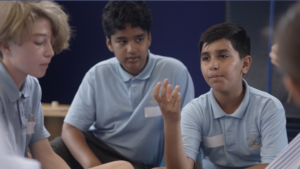
Moral Dilemmas
Moral dilemmas tap into our intuitive senses of right, wrong, fairness, and justice. They also encourage us to weigh up contextual factors like consequence, time and motives.
Philosopher Rushworth Kidder believed there are four types of moral dilemma. Explore Truth vs Loyalty and Justice vs Mercy.

Oracy activities for EYFS & KS1
We've made a dedicated page for EYFS & KS1 featuring some of our favourite oracy resources, activities and games.

Oracy teacher tips
Training teachers is out bread and butter, so we create a wealth of resources giving teachers tips on what to do more / less of in the classroom to help develop oracy. All of this is published in our books and delivered in our training, but here are three key ideas we think all teachers must know.
Small Talk Before Big Talk
When did you last have a meeting where the very first thing you spoke about was the subject of the meeting? Unless you are getting fired or firing someone, it almost never happens. A meeting without preliminary small talk lacks the human touch.
Yet when we get children to work in groups, we don’t usually leave any space for that small talk to take place. We assume that they are primed and ready to talk about whatever we want them to talk about.
But often, the small talk either intrudes anyway, or doesn’t happen and therefore the “Big Talk” is from a cold start and feels stilted.

Start in the world of the child
We've all been there - we want children to discuss a rich concept or idea, but going straight into the main question feels like diving in at the deep end.
Starting in the world of the child means to float the theme of what you'll end up talking about in a context they're familiar with. Here are three simple ways you can do it.
Serve and Return
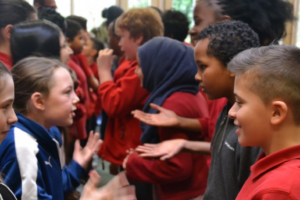
In other words, you can talk at a child as much as you like, or have them listen in to adult conversation, but what really counts are the “serve and return” interactions in which adult or child speaks, and child or adult responds based on what they have heard. fMRI scans show greater brain activity in such interactions compared to other forms of speech and listening.
Sticky Questions:
A school-wide approach oracy
Have you done your homework?
...can be a thorny question. However, learning at home really matters, especially when it comes to speaking and listening.
That's why we've introduced Sticky Questions - our unique approach to homework where children take home a juicy philosophical puzzler stuck to their jumper, chat at home and bring their thoughts back to school.
At 3.7p per child per week, it's no wonder it's proving incredibly popular! See it in action at Stivichall Primary School below.
One day each week, all the children go home with a sticker on their jumper. Instead of having a conversation about, “Have you done your homework”, the homework IS the conversation. Then the following day, the discussion can carry on at school, drawing on ideas from home.
Over the course of 7 years from Reception to Year 6, children will get the chance to think about nearly 300 different questions – a memorable mix of the philosophical and some more free-wheeling creative stuff.
All packs will include ideas on how to carry on the discussion back in school, and how to support children who get less support from home, how to involve grandparents and so on.
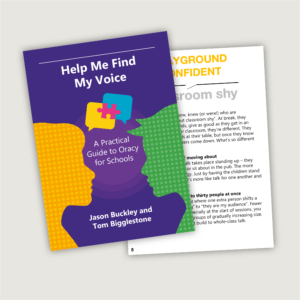
Our latest book: Help Me Find My Voice
This practical A6 guide to oracy explores why kids don’t talk in class – from kids who are “playground confident, classroom shy” to those who need to be someone else before they can be themselves. It’s fifteen years of experience of getting kids talking, boiled down to twelve principles you can use in every setting.
We hope this book arms you with the strategies you need to make one of the biggest differences you can – helping a child find their voice.
Interested by our oracy training?
We visit schools week-in, week-out, working with staff and pupils.
Interested in training?
Contact us today to arrange a chat - choose from any of the options below.
Feedback from recent training. Can you spot the buzzword?
"I cannot describe the buzz and vibe from the staff, all down to you."
"You really did create a huge buzz in school, which is a difficult shout on the first day back! You covered everything we wanted out of the training and gave us mountains of material to use in class. I loved the fact you gave each phase some planning time to discuss ideas and plan sessions and then trial them out of colleagues. You have definitely given us some inspiration and I am very excited to see what happens next."
"There was a buzz during the staff meeting, which for any member of staff attending a staff meeting knows this is a rare thing! All the staff said how enthused and excited they felt to get back into their classrooms and try out the methods they had been shown."
"The questions raised interested everyone and there was a real buzz in the room. Our training was full of practical activities and games, with the just the right amount of discussion about teaching techniques interspersed. What an inspiring day!"
"It is us who would like to thank you. It was such an inspirational INSET and the staff were truly excited. The enthusiasm and buzz is palpable!"